Ottawa and Gatineau are one market split by a river. Customers cross the bridges every day, many teams work on both sides, and a booking, delivery or field-service app built in Ottawa often ends up on phones in Gatineau. That raises a practical question early in any app project: does it need to be in French?
In Ontario, French is usually a business decision for a private company. In Quebec, it is generally a legal requirement. This guide explains what Quebec’s rules say about apps in plain English, and how to build English and French in from the first design, which is much easier than adding French later.
The short version
- If you do business in Quebec, the Charter of the French Language generally requires software, including apps, to be available in French, on terms at least as good as any other language.
- Standard terms of use and other adhesion contracts have to be offered in French first.
- Employers in Quebec must give staff the French version of the software they use at work, including in-house apps.
- Plan both languages from day one: keep text out of the code, leave room for longer French text, and format dates and prices for each language.
- This is a practical guide, not legal advice. Confirm your situation with the OQLF or a Quebec lawyer.
Why an Ottawa app often needs French
Daily life in the Ottawa–Gatineau region crosses the river: shopping, appointments, work and deliveries. If your app takes bookings, sells products or sends technicians to customers, some of those customers are likely in Quebec. And even on the Ontario side, many of your users will be more comfortable in French.
There is a business reason too. People are more likely to finish signing up and keep using an app that speaks their language. If you plan to sell to organizations in Quebec, a French version is usually one of the first things they ask about.
What Quebec’s rules say about apps, in plain English
The Charter of the French Language sets the rules for French in Quebec, and the Office québécois de la langue française (OQLF) applies them. Bill 96, passed in 2022, strengthened the Charter, with changes coming into force in stages up to June 1, 2025. These are the parts that matter most for an app:
| What | What the rules say | What it means for your app |
|---|---|---|
| Apps and software offered to the public | Must be available in French, unless no French version exists. Other languages are allowed if the French version is available on terms that are no less favourable and has at least equivalent technical features. | A complete French version, with the same features and price as the English one. |
| Websites and promotional material | Commercial publications, which the OQLF says include websites and social media, must be in French. Other languages are allowed alongside French. | Your website and app marketing need French versions. |
| Terms of use and other standard contracts | Since June 1, 2023, adhesion contracts must be offered in French first. The parties can then choose another language if they expressly want to. | Show French terms before users accept, or use a bilingual version. |
| Software used by staff in Quebec | Employers must provide the French version of any software, in-house or not, installed in French by default. | Staff apps used by a team in Quebec need French too. |
Sources: the OQLF’s pages on software at work and adhesion contracts, and its guidance for businesses. The rules have exceptions and details that depend on your situation, so check with the OQLF or a Quebec lawyer before you launch.
Build both languages in from day one
Adding French to an app designed only in English usually means hunting down every hard-coded word, reworking screens where the French text doesn’t fit, and testing everything again. Planning both languages from the start mostly adds translation and testing time. Here is how we approach it:
- Keep every word out of the code. Screens, error messages, push notifications, emails and receipts all read their text from language files, so adding or fixing a translation never means changing the app’s logic.
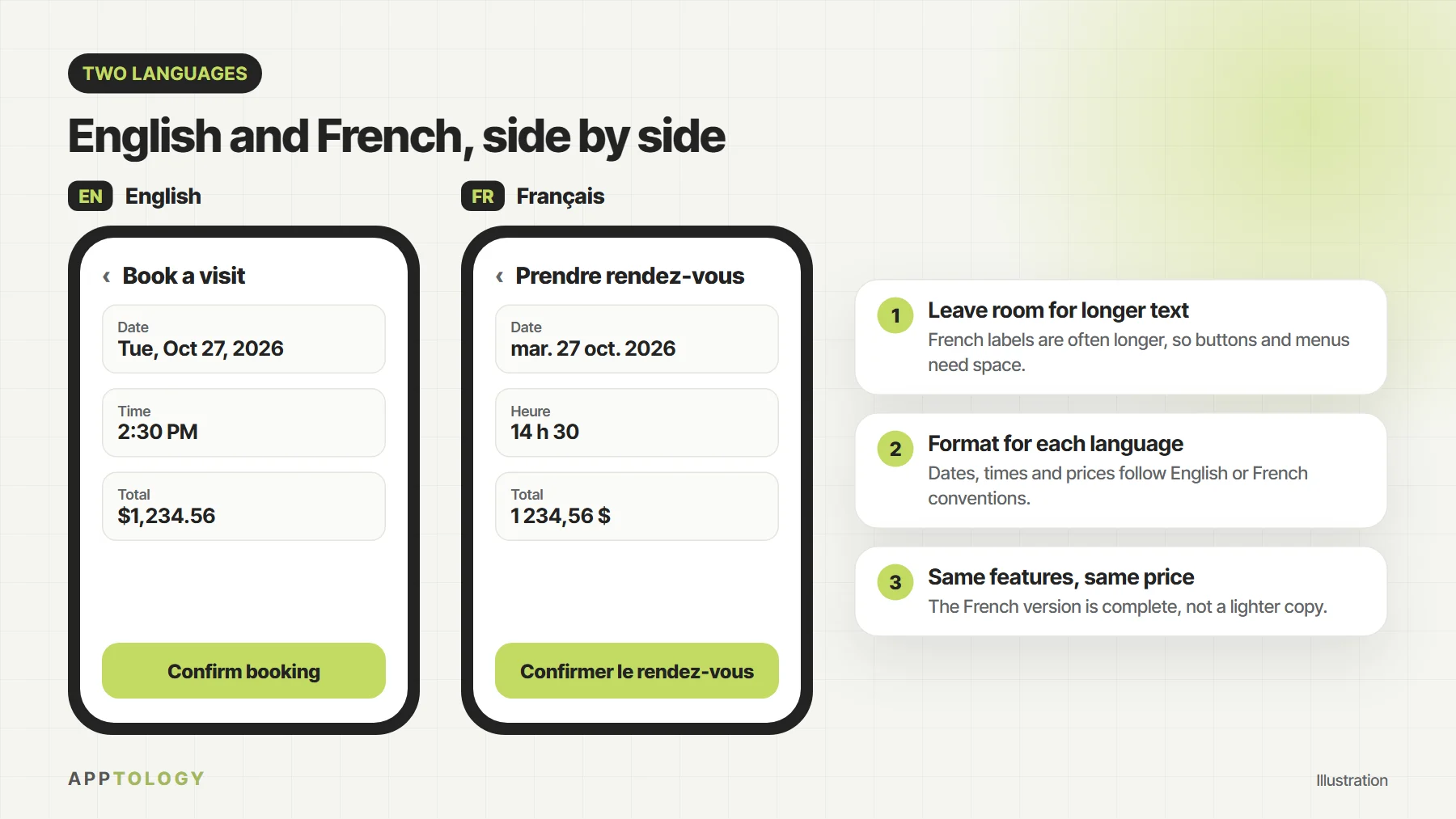
- Design for longer text. French labels are often longer than English ones. Buttons, tabs and menus need room to grow, and every screen should be checked in French on a small phone.
- Format for each language. In English, a price reads $1,234.56. In Canadian French, it reads 1 234,56 $. Dates and times change too: 2:30 PM becomes 14 h 30.
- Let people choose. Start in the phone’s language, and keep a language switch on the first screen or in the settings.
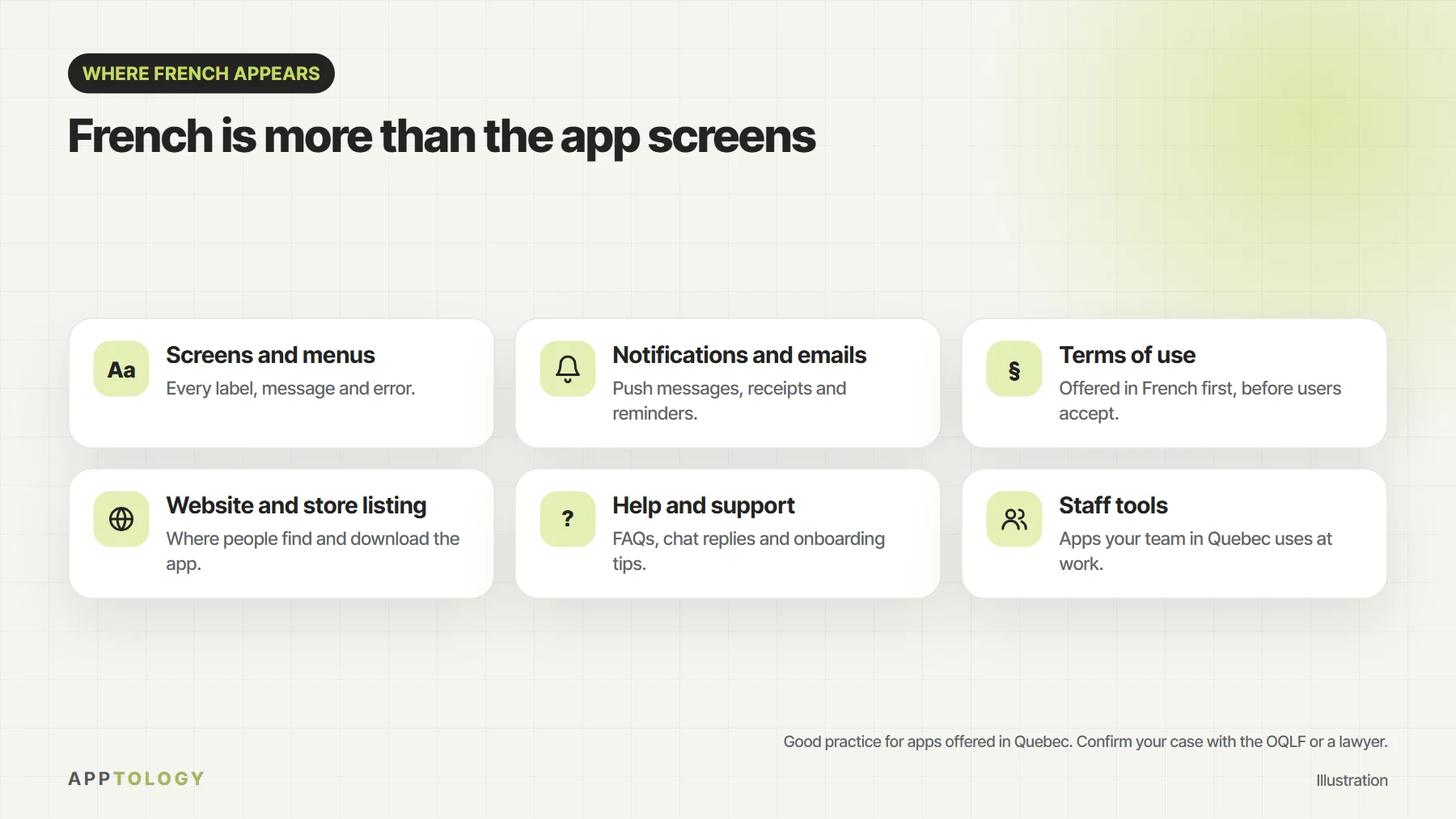
- Translate everything users see. App store listings, notifications, emails, help pages and terms of use, not just the screens.
- Use a professional translator for the final text. Machine translation is fine for drafts, but have a translator who knows Canadian French review payments, legal terms and safety messages.
Where the language choice fits
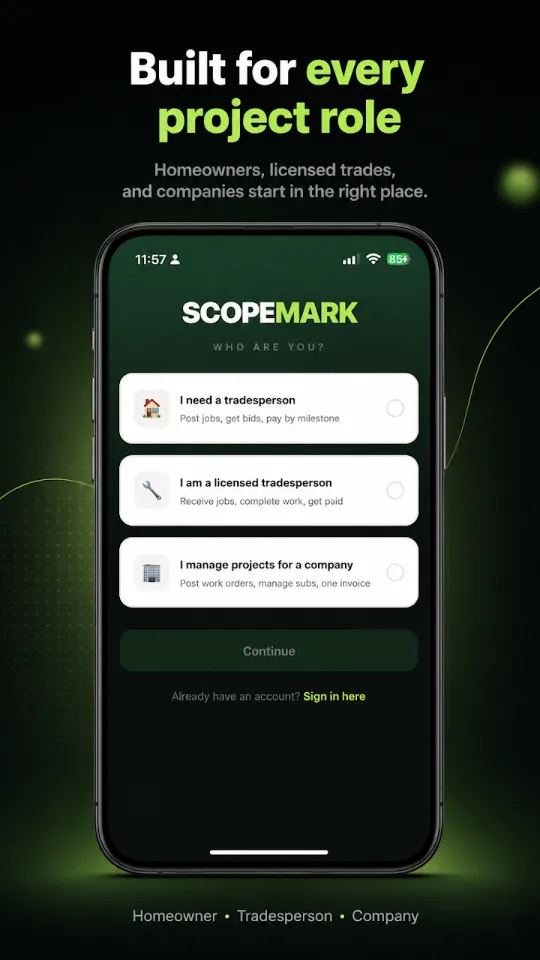
A good place to offer the language choice is the first screen, before sign-up. In ScopeMark, a contractor platform we designed and built, the first screen asks who you are: a homeowner, a licensed tradesperson or a company. A language choice can sit in that same first step, so every screen after it appears in the right language.
What French adds to the cost
The cost of a second language depends mostly on how much text your app has and how often it changes. A small booking app might have a few hundred phrases; a platform with several user roles, emails and help pages can have thousands. When French is in the plan from the start, the extra work is mostly translation and testing. When it is added later, it can mean reworking screens and code. Our app cost guide lists typical starting prices in Canadian dollars, and you can ask for French to be included in your written proposal.
Checklist before you launch in Quebec
Building an app for Ottawa and Gatineau?
We design and build iOS, Android and web apps in English and French, from our Ottawa office. Tell us about your idea and get a written proposal with scope, timeline and price.
Vous préférez le français? Lisez notre page sur le développement d’applications mobiles à Gatineau.
Frequently asked questions
Does my app have to be in French in Ontario?
For most private businesses in Ontario, French is a business choice rather than a legal requirement. If you do business in Quebec or offer the app to customers there, Quebec’s Charter of the French Language applies, so check its rules before you launch.
Can an app be in both English and French in Quebec?
Yes. Other languages are allowed as long as the French version is available on terms that are no less favourable and has at least equivalent features. Many apps start in the phone’s language and offer a switch.
Is machine translation good enough for an app?
It is useful for drafts. For the final text, have a professional translator who knows Canadian French review it, especially payments, legal terms and safety messages.
Is it cheaper to add French later?
Usually not. Adding French later often means finding hard-coded text and reworking screens. Planning both languages from the first design mostly adds translation and testing time.
Read next: App development in Ottawa, How to choose an app development company in Canada and How much does an app cost in Canada?.