One of the first questions in many Canadian app projects is whether a government program can pay for part of it. The honest answer: sometimes, but not always for the reasons people expect. Building a standard app with proven tools usually doesn’t qualify. Solving a technical problem nobody knows how to solve yet might.
This guide covers the two programs app projects ask about most, SR&ED and NRC IRAP, what tends to qualify, and how to plan your project so the paperwork is easier. It is a starting point, not tax advice: your accountant or an SR&ED specialist should confirm your case.
The short version
- Most routine app development does not qualify for SR&ED. Work that resolves a real technological uncertainty through systematic investigation can.
- Most Canadian-controlled private corporations earn a refundable 35% SR&ED credit on qualified expenditures up to an annual limit, and 15% above it.
- NRC IRAP supports innovative technology projects at incorporated, for-profit businesses in Canada with up to 500 full-time employees. You start by talking to an advisor.
- The Canada Digital Adoption Program is closed to new applications.
- Plan before you build: talk to your accountant, keep technical records from day one, and agree with your developer who will claim.
SR&ED and IRAP at a glance
| SR&ED | NRC IRAP | |
|---|---|---|
| What it is | A federal tax incentive for scientific research and experimental development | Advice and funding from the National Research Council for innovative technology projects |
| Who can use it | Corporations, individuals and trusts. Partners in a partnership can claim; the partnership itself can’t. | Incorporated, for-profit businesses operating in Canada with up to 500 full-time employees |
| How it pays | Investment tax credits claimed with your tax return, after the work is done | Funding agreed with IRAP for a specific project |
| What qualifies | Work that seeks a technological advancement, faces technological uncertainty and follows a systematic investigation | Projects that develop or adopt innovative technology to help the business grow |
| First step | Talk to your accountant or an SR&ED specialist | Contact NRC IRAP to speak with an industrial technology advisor |
What counts as SR&ED in an app project
The CRA looks for three things: the work aims for a technological advancement, it faces a technological uncertainty that standard practice can’t resolve, and it follows a systematic investigation, such as forming a hypothesis, testing it and recording the results. Its eligibility guidelines are clear that routine development, and work-arounds that use existing knowledge, don’t count.
In practice, most of a typical business app is routine: sign-up and login, payments through a provider such as Stripe or Moneris, an admin dashboard, notifications and the visual design. They matter a lot to users, but they are built with known methods. The parts that might qualify are narrower, for example an algorithm that has to meet a performance target no known method meets, or AI that has to run on a phone within limits nobody knows are achievable.
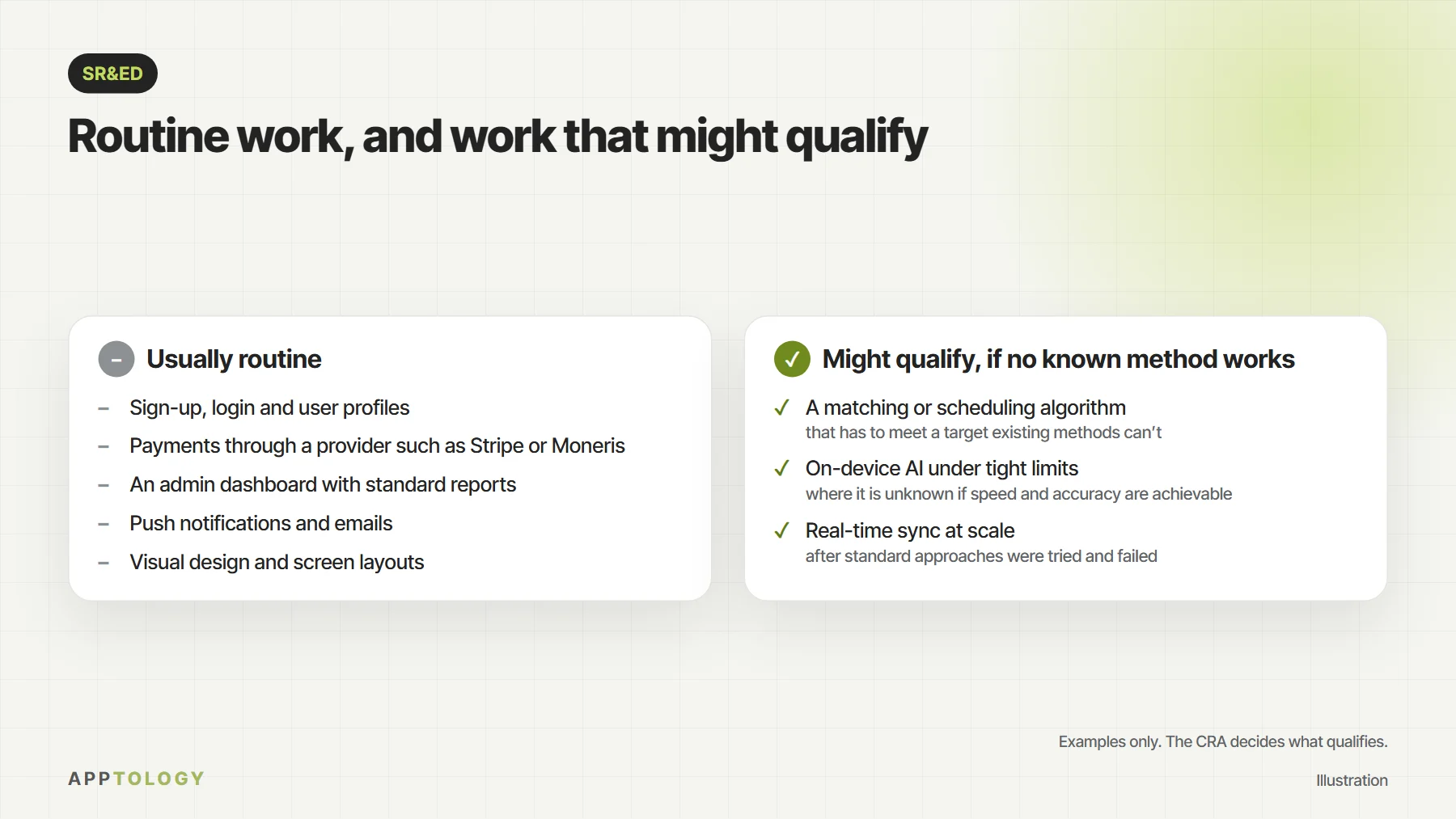
Even then, a claim covers the experimental work, not the whole app. A project might have one uncertain feature among many routine ones, and only that work, properly documented, could count.
How much SR&ED can return
According to the CRA, most Canadian-controlled private corporations (CCPCs) earn a refundable investment tax credit at the enhanced rate of 35% on qualified SR&ED expenditures, up to an annual expenditure limit. The CRA lists that limit as $6 million for tax years beginning after December 15, 2024, and $3 million before. Spending above the limit earns the basic rate of 15%. See the CRA’s investment tax credit page for the current details.
For example, if $100,000 of a CCPC’s expenditures qualify, a 35% credit would be $35,000. Which costs qualify, such as salaries or payments to contractors, is set by detailed rules, so your accountant should calculate the real figure. Provinces, including Ontario and Quebec, have their own R&D tax credits too; ask your accountant how they combine with the federal credit.
Timing matters as well: the CRA’s deadline for a claim is 12 months after the filing due date of your income tax return for the year the work was done.
NRC IRAP: talk to an advisor first
The National Research Council’s Industrial Research Assistance Program (IRAP) supports innovative technology projects at small and medium-sized businesses. According to NRC, a business must be incorporated, for-profit and operating in Canada, with up to 500 full-time employees. Sole proprietorships, partnerships, co-operatives, and unlimited or limited liability companies (ULCs and LLCs) are not eligible.
Eligible businesses are referred to an industrial technology advisor, who looks at the project and the company’s plans. You can reach IRAP at 1-877-994-4727. Contact them before you start the work you hope to fund, and be ready to explain what is technically new and how the project helps your business grow.
What about the Canada Digital Adoption Program?
The Canada Digital Adoption Program (CDAP), which helped many small businesses with website and technology costs, is closed to new applications. Its Boost Your Business Technology stream stopped accepting applications on February 19, 2024. If an older article mentions it, check a program’s current status before you plan around it.
How to plan an app project for funding
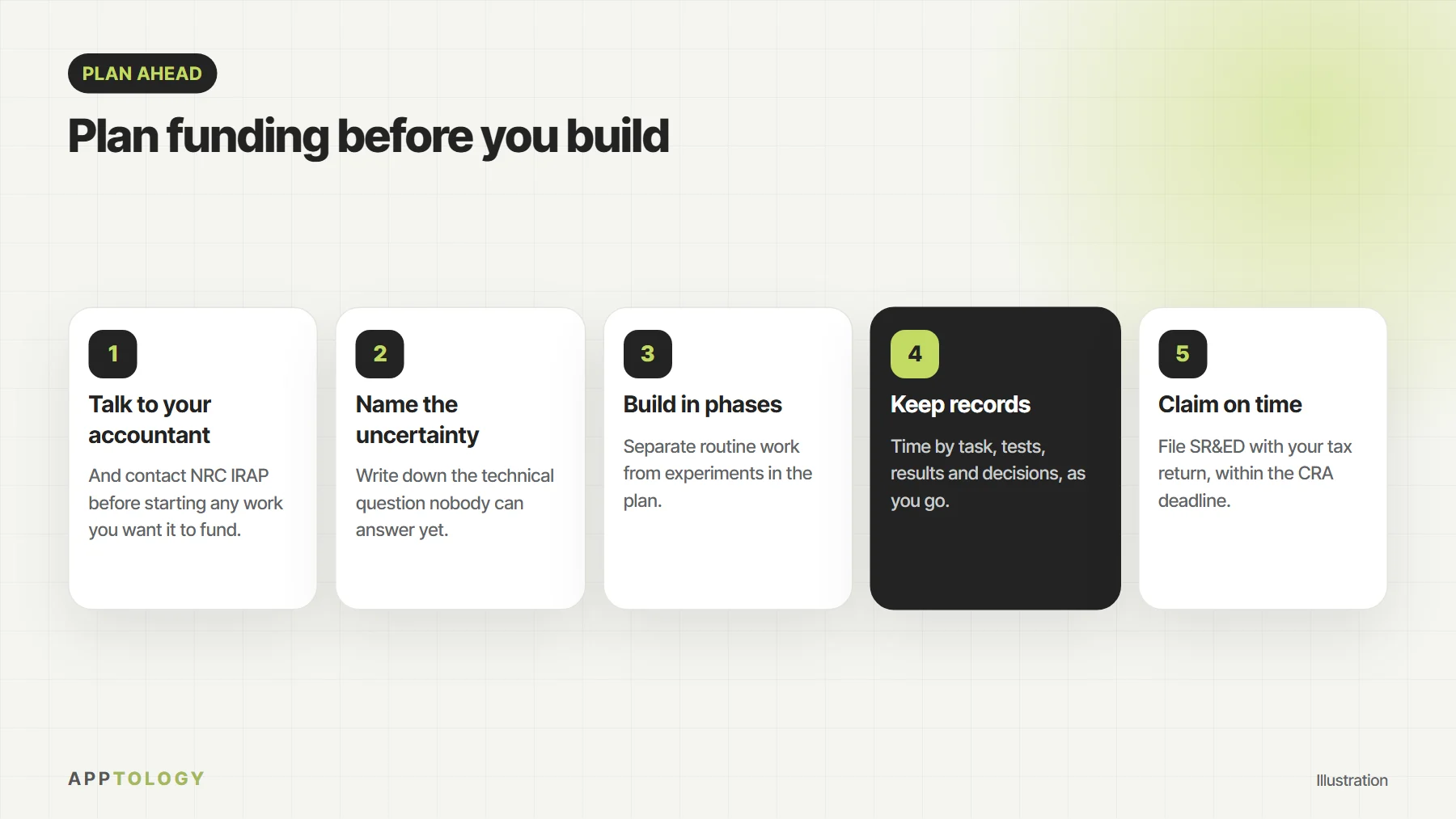
- Talk to your accountant first. Confirm your company type, your tax year and whether SR&ED or IRAP is realistic for your project.
- Name the uncertainty. Write down, in a few sentences, the technical question you can’t answer with existing knowledge.
- Plan in phases. Separate routine features from experimental work, so the experimental part has its own scope, time and results.
- Keep records as you go. Time by task, test plans, results, failed attempts and decisions. Records made during the work are much stronger than ones written afterwards.
- Agree who claims. If an outside developer does the work, agree in writing which party will make any claim, and keep the technical records together.
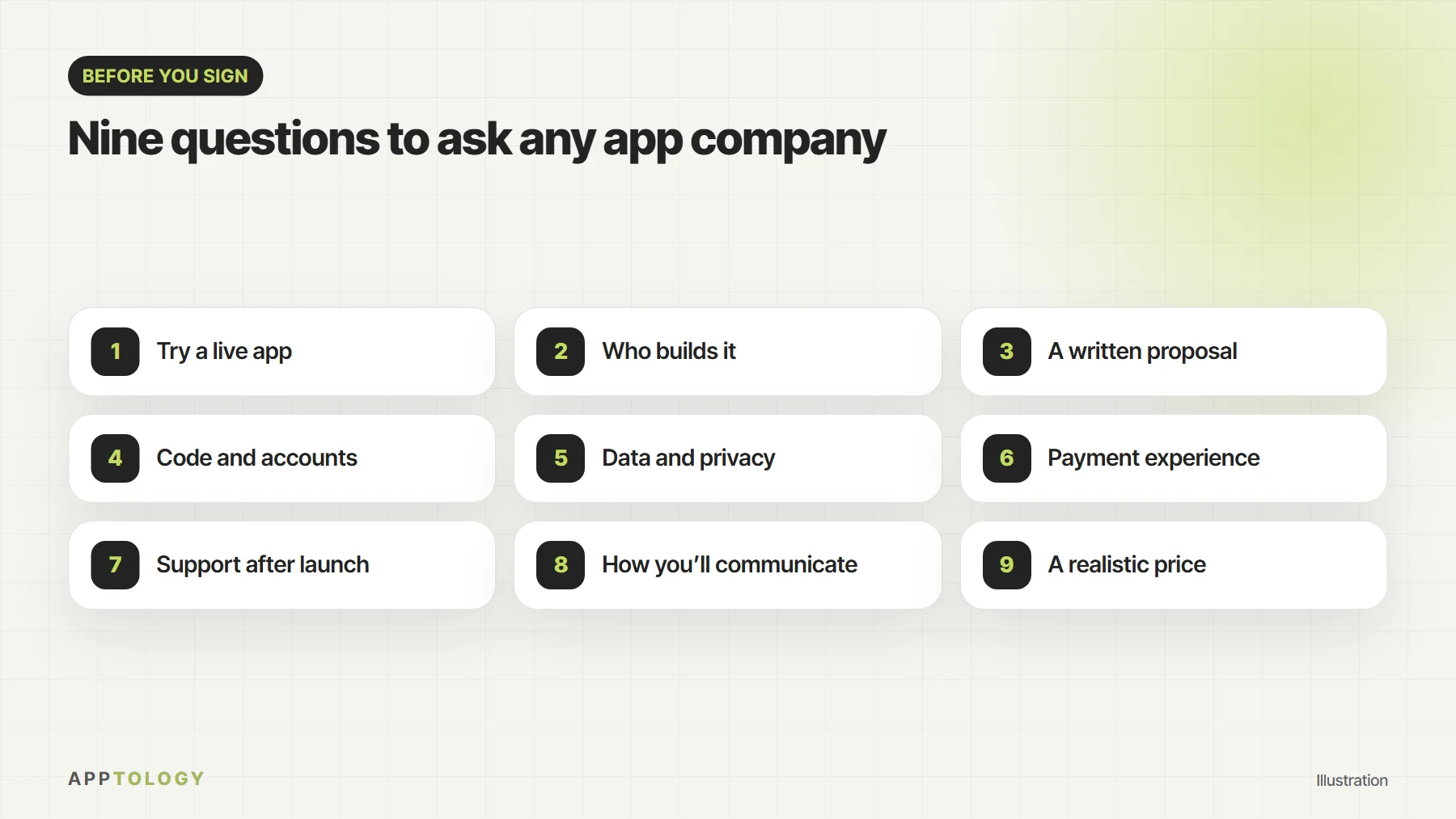
Our written proposals set out the scope, timeline and price before any work starts, and we can split a project into phases so the experimental part is easy to see. We don’t prepare SR&ED claims ourselves; that is a job for your accountant or a specialist. If you are still comparing developers, our guide to choosing an app development company in Canada lists nine questions to ask.
Checklist before you apply
Planning an app for 2027?
Get a typical price range in two minutes with our estimator, then a written proposal with scope, timeline and price after a free call.
Frequently asked questions
Does app development qualify for SR&ED?
Sometimes. Routine development with known methods doesn’t. Work that tries to resolve a technological uncertainty through systematic investigation can. Usually only part of an app project qualifies, and the CRA decides.
What is the SR&ED rate for small businesses?
Most Canadian-controlled private corporations earn a refundable 35% credit on qualified expenditures up to an annual limit, which the CRA lists as $6 million for tax years beginning after December 15, 2024. Above the limit, the rate is 15%.
Can a sole proprietor get IRAP funding?
No. NRC says the business must be incorporated and for-profit. Sole proprietorships and partnerships are not eligible.
Is the Canada Digital Adoption Program still open?
No. CDAP is closed to new applications.
Can I claim SR&ED if I hire a developer?
Payments to a contractor can count in some cases, but the rules are detailed. Agree in writing who will claim, keep the technical records, and check with your accountant.
Read next: How much does an app cost in Canada?, AI features for business apps and App development in Ottawa.