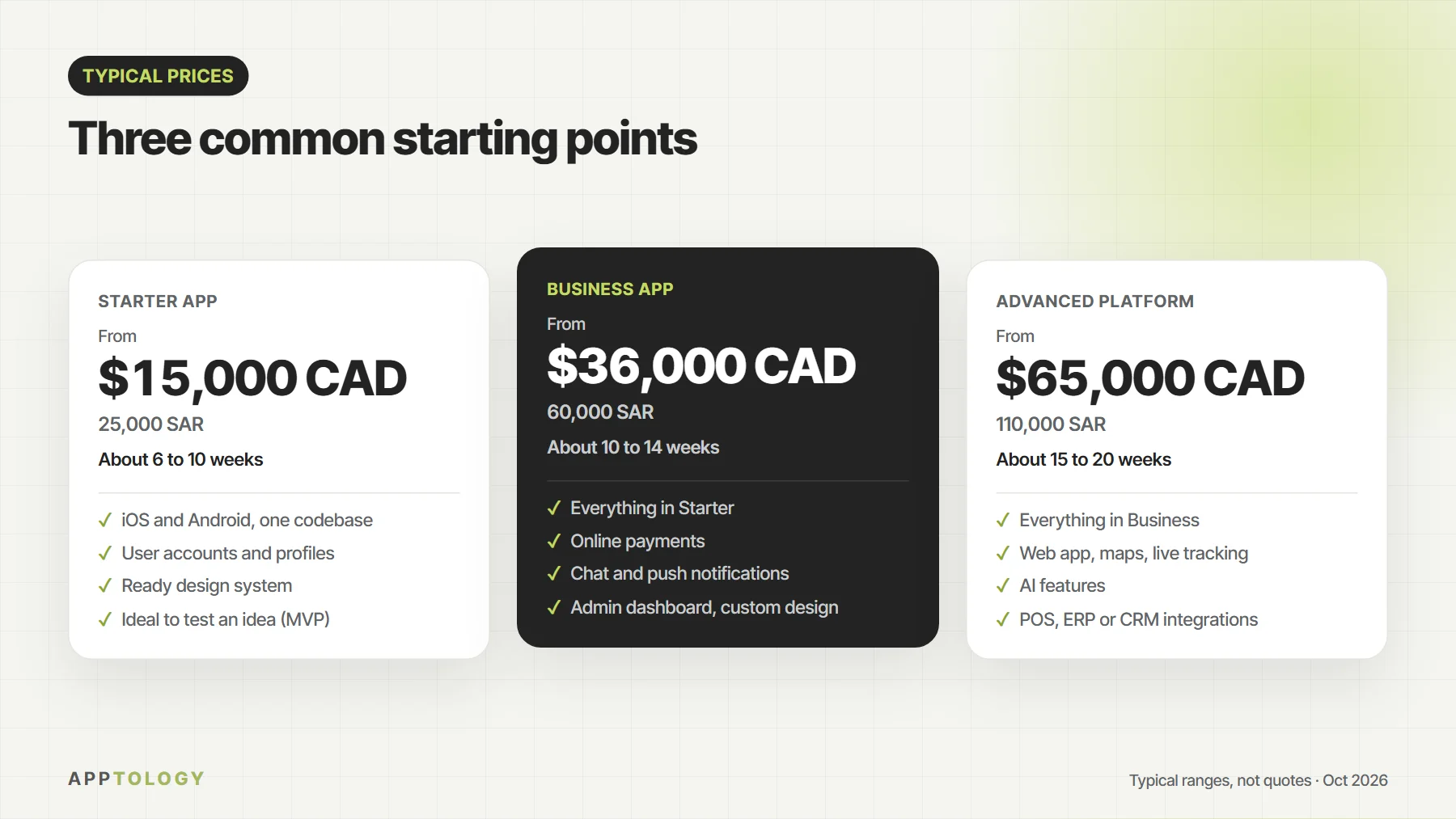
At Apptology, a starter app typically costs from $15,000 CAD (25,000 SAR), a business app from $36,000 CAD (60,000 SAR) and an advanced platform from $65,000 CAD (110,000 SAR). Where your app lands depends on what it needs to do: two apps that look alike can take very different amounts of work. This guide explains what drives the cost, how to keep your budget under control and how we put together a quote.
To see where your own app might land, try our typical app prices and cost estimator.
Key takeaways
- Most apps we build cost between $15,000 and $110,000+ CAD (25,000 to 185,000+ SAR).
- The biggest cost driver is the number and complexity of features in the first version.
- The backend and admin tools are often as much work as the app itself.
- Plan for ongoing costs too: hosting, app store accounts and updates.
- Start with a focused first version, then add features in phases.
Typical prices at a glance
| Type of app | From (CAD) | From (SAR) | Typical time | Usually includes |
|---|---|---|---|---|
| Starter app | $15,000 | 25,000 | 6 to 10 weeks | iOS and Android from one codebase, user accounts, ready design system |
| Business app | $36,000 | 60,000 | 10 to 14 weeks | Everything in Starter, online payments, chat and notifications, admin dashboard, custom design |
| Advanced platform | $65,000 | 110,000 | 15 to 20 weeks | Everything in Business, web app, maps and live tracking, AI features, POS, ERP or CRM integrations |
Typical ranges, not quotes. Prices exclude taxes, app store fees and third-party services.
What drives the cost of a mobile app
1. Platforms
Do you need iOS, Android, a web app, or all three? Building one shared codebase for iOS and Android (cross-platform) is usually more efficient than two separate native apps, while some apps with heavy device features still benefit from native code. A web dashboard for your team or admins is often needed alongside the mobile app.
2. Features and complexity
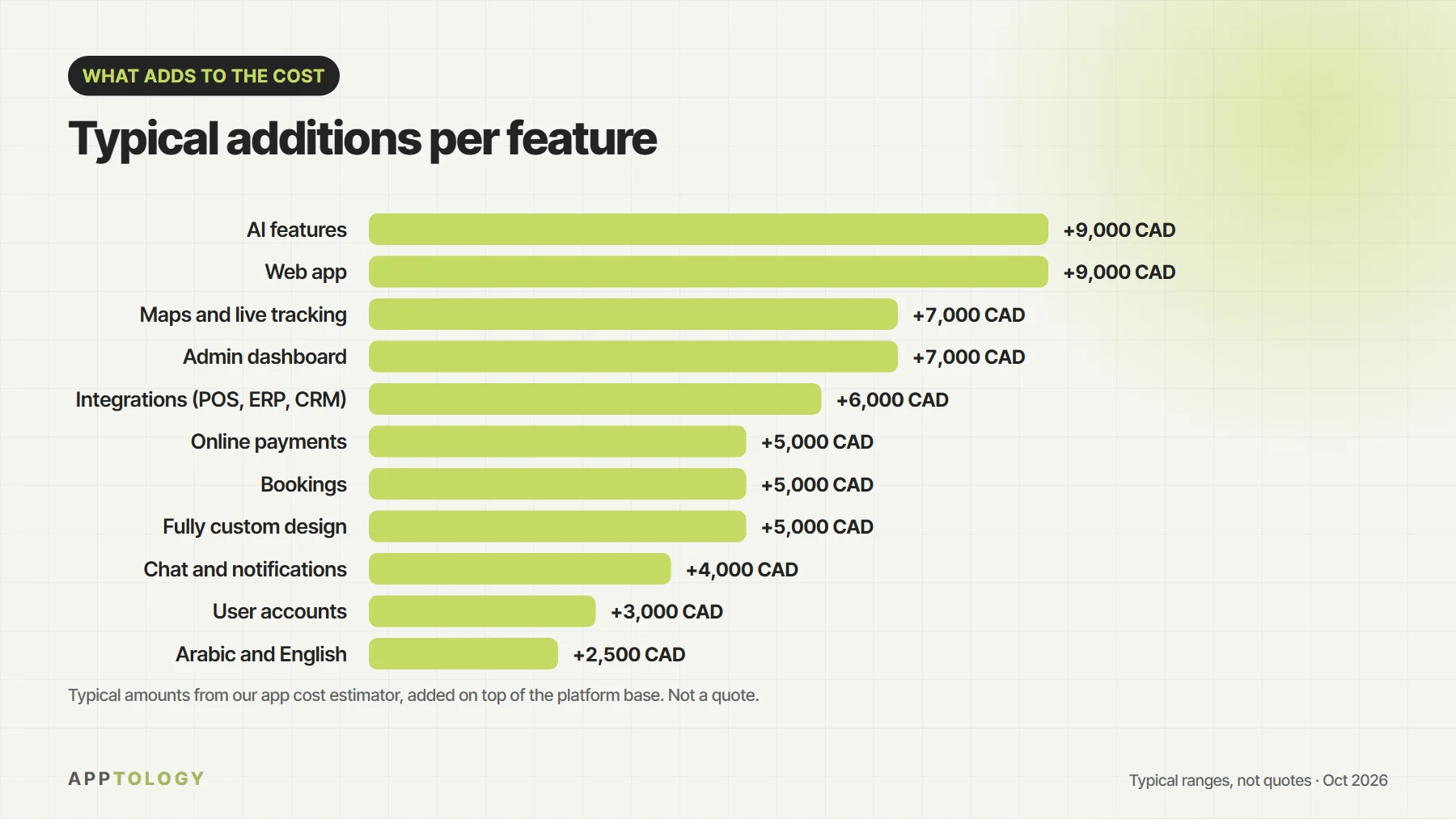
Every screen and rule adds work. A menu or information app is simple. Accounts, bookings, payments, chat, maps, offline mode and role-based permissions each add design, development and testing time. The single biggest factor in cost is the number and complexity of features in the first version.
3. Design
Good design is not decoration. Mapping user journeys, building clickable prototypes and testing them before development prevents expensive changes later. Custom branding, animations and accessibility work add time, but they also make the app easier to use.
4. Backend and admin tools
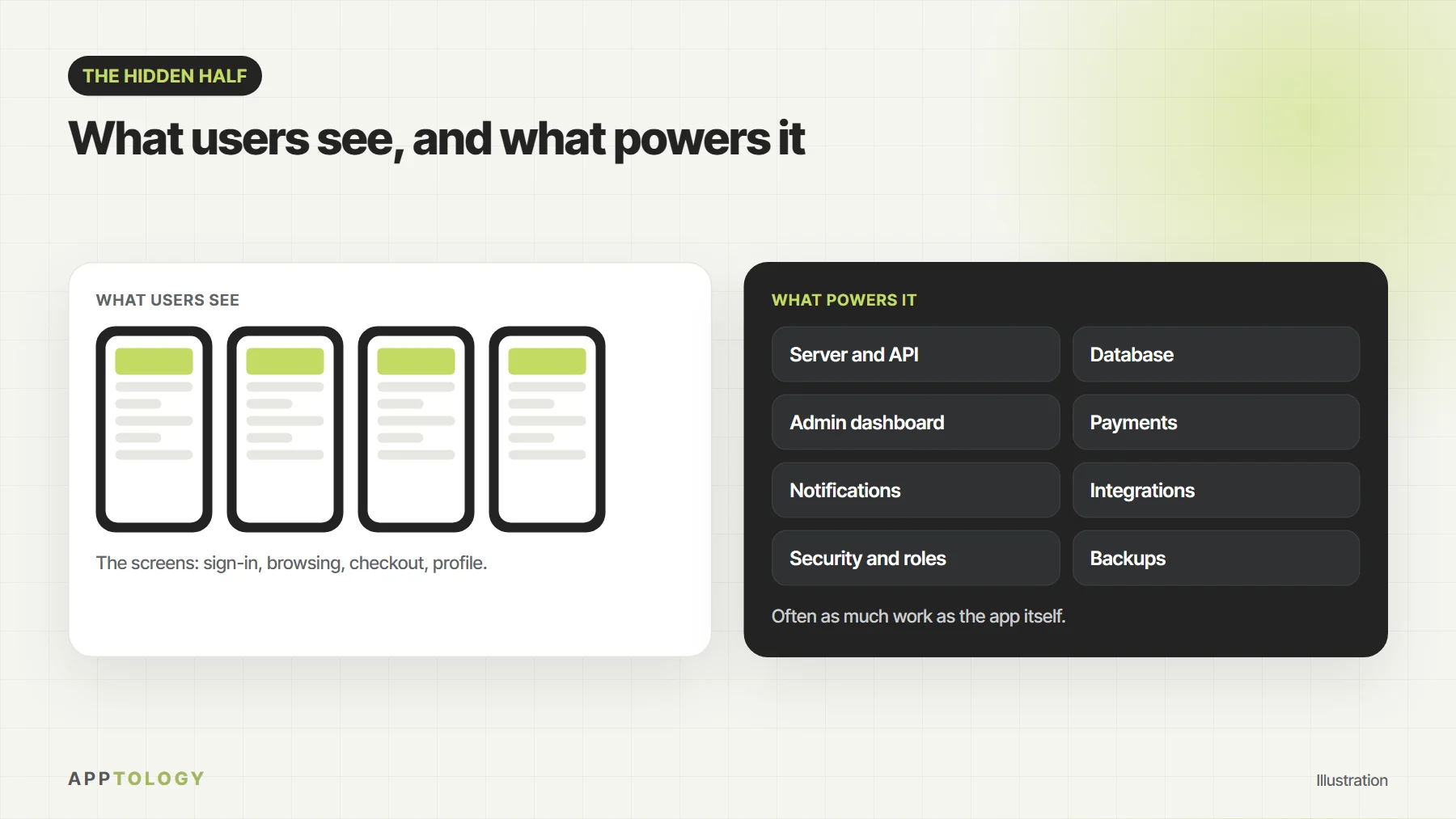
Most business apps need a backend: a server, a database, an API and an admin panel where your team manages content, users and orders. This “invisible” part of the app is often as large as the app itself.
5. Integrations
Connecting to payment providers, your POS, ERP, CRM, delivery platforms or listing sites saves your team time, but each integration depends on the other system’s documentation and quality, so it needs to be scoped carefully.
6. AI features
Assistants, recommendations, document reading and smart search can add real value. They also add usage-based costs from AI providers, so we plan them around clear use cases rather than adding AI for its own sake. See seven AI features business apps use today.
7. Languages
Apps for Saudi Arabia and Canada often need English and Arabic. Full right-to-left support affects layouts, fonts and testing, so it is best planned from the start rather than added later.
Building in a specific city? See our pages for app development in Ottawa, Toronto and Riyadh.
Get a typical range for your app in two minutes
Tick the platforms and features you need in our estimator, then get your exact price after a free call.
Ongoing costs after launch
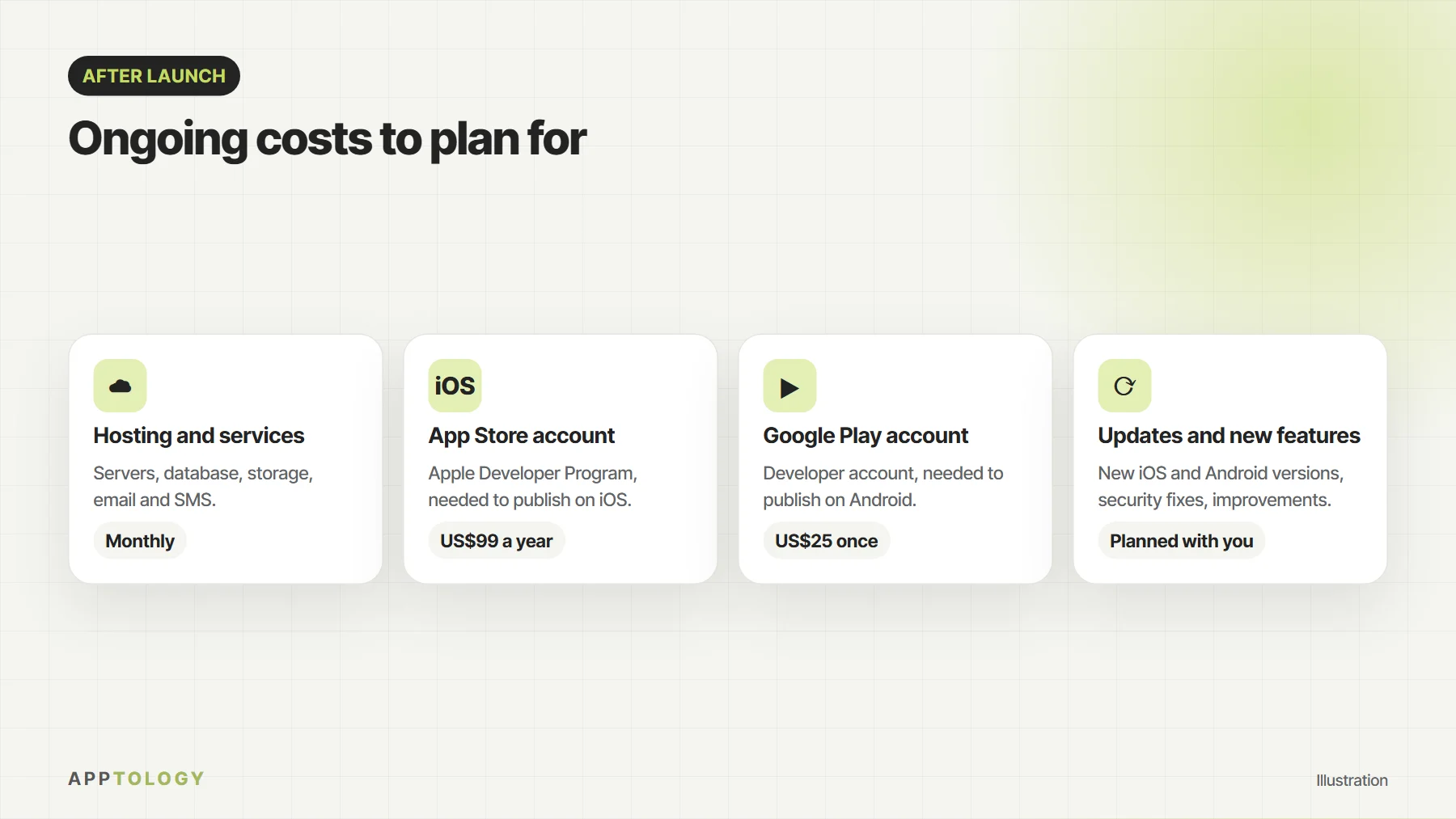
- Hosting and services: servers, databases, storage, email and SMS providers, usually billed monthly.
- App store accounts: Apple’s Developer Program costs US$99 per year, and a Google Play developer account has a one-time US$25 registration fee.
- Updates and maintenance: new iOS and Android versions, security updates and bug fixes.
- New features: most successful apps keep improving based on what users actually do.
How to control your budget without cutting quality
- Start with a focused first version. Launch the features that solve the main problem, learn from real users, then add more.
- Prototype before you build. Changing a design is much cheaper than changing finished code.
- Use proven services. Payments, maps, notifications and sign-in do not need to be built from scratch.
- Plan in phases. Clear phases with clear deliverables keep costs predictable.
- Choose one team for the whole journey. Handing an app between agencies usually costs more than it saves.
How we quote at Apptology
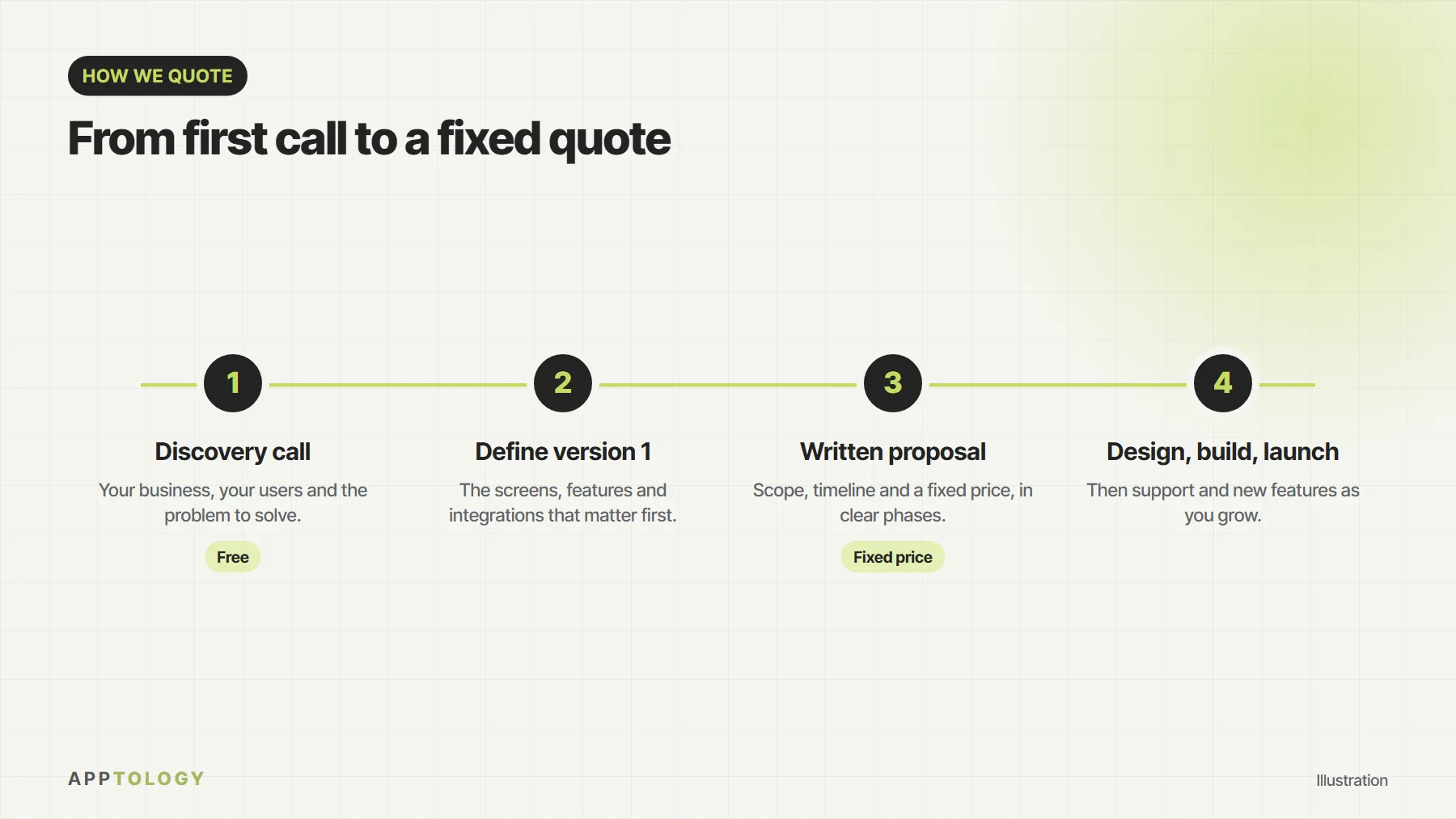
We start with a short discovery session to understand your business, your users and the problem the app should solve. From there we define the first version, the screens and the integrations, and give you a fixed quote with clear phases: design, build, launch and support. You know what you will get and what it costs before development starts.
You can see the kind of products we build in our ScopeMark and PrimeAuto case studies, or read more about our mobile app development services.
Frequently asked questions
How long does it take to build an app?
A starter app takes about 6 to 10 weeks, a business app about 10 to 14 weeks and an advanced platform about 15 to 20 weeks, depending on features and how quickly content and decisions are ready.
What is not included in the price?
Our typical prices exclude taxes, app store fees and third-party services such as hosting, SMS or maps, which those providers bill directly. We list them in your proposal so there are no surprises.
How much does it cost to add AI features?
In our estimator, AI features typically add about $9,000 CAD (15,000 SAR) to the build, plus usage-based costs from the AI provider. See AI features for business apps for examples.
Do you give a fixed price?
Yes. After a short discovery call, we send a written proposal with the scope, timeline and a fixed price in clear phases, before development starts.
Is it cheaper to build for iOS or Android first?
With a cross-platform approach you usually get both from one codebase, which is often the most efficient option. If your audience is mostly on one platform, launching there first can also make sense.
Can I start small and add features later?
Yes, and we recommend it. A well-structured first version makes it easy to add features in later phases without rebuilding.
Do you work with businesses in Saudi Arabia and Canada?
Yes. We have offices in Ottawa and Riyadh and build apps in English and Arabic.
Have an app idea? Tell us about it and we will suggest the best way to build your first version.